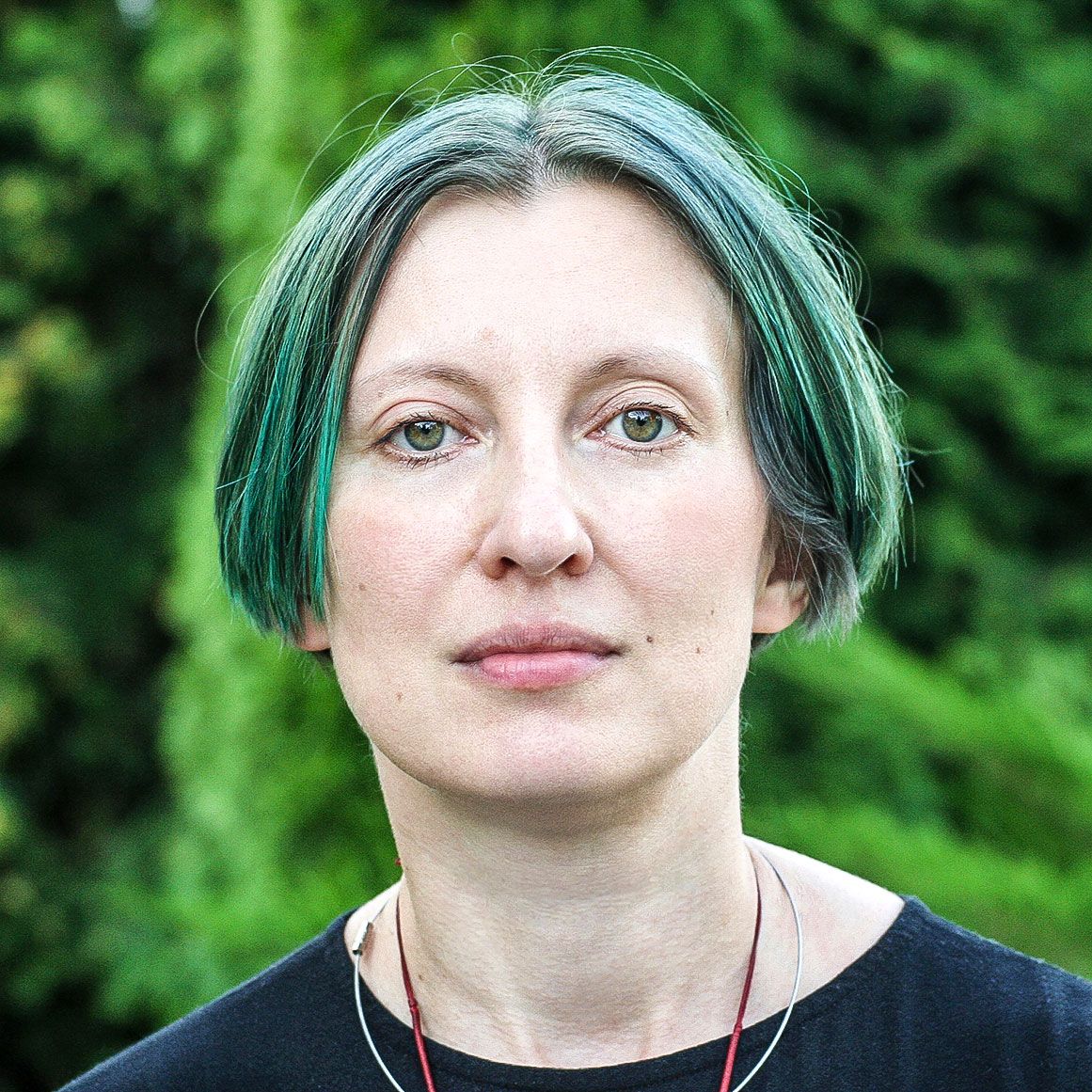
Critics accuse the creators of the documentary «Mr. Nobody vs. Putin» of exaggerating the scale of brainwashing in Russian schools for a Western audience. But researcher Dmitry Tsibiryov (project «Not the Norm») knows: in reality, the situation is now much worse than what is shown in the film.
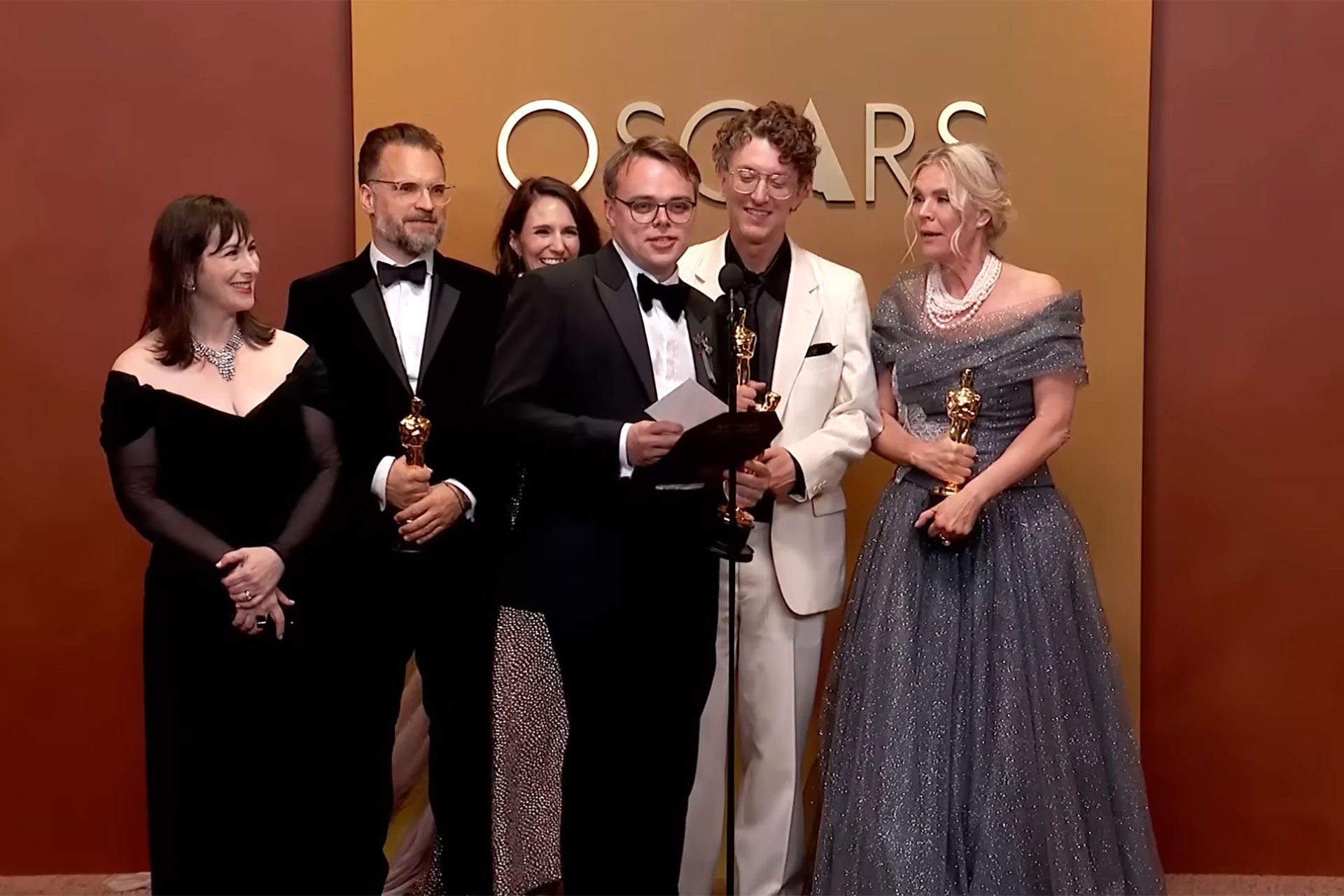
The creators of the film «Mr. Nobody vs. Putin» talk to the press after receiving the award for Best Documentary at the 98th Academy Awards. Photo: Oscars via YouTube
- You launched the research project «Not the Norm« about propaganda in schools and kindergartens shortly after Russia’s invasion of Ukraine. How much evidence have you collected since then?
- To be honest, we don’t keep those kinds of statistics—we only record the number of publications. But right now we are preparing for open publication an archive that contains data on more than 30,000 Russian schools—these are their official pages on VKontakte and over 70 million posts. Of course, not all of these are propaganda—there’s plenty of regular content too. We’re currently organizing the archive and preparing a website to make it publicly accessible. We’ve already conducted a number of studies based on it: for example, regional samples, like on data from Chuvashia. Recently, a piece with «Verstka» came out based on this archive. At that time, it was about 60 million posts, now it’s over 70 million.
We’ve studied not only militaristic propaganda in schools, but also reproductive propaganda—which in recent years has become one of the leading topics of indoctrination.
We publish only a part—what seems most significant or illustrative to us: new forms, new topics, especially egregious cases. But that’s far from the full volume. If we show a few schools, in reality there are dozens or hundreds of such cases across the country.
- And how did you even decide to start collecting evidence of state propaganda in schools?
- Initially, the idea of the project was a bit different. We started working on this in 2022, almost immediately after the start of the full-scale invasion. Back then, it seemed like all these «lining up children to form the letter Z» and similar actions were the initiative of individual teachers or principals. We thought it would be a minority—some especially zealous school principals who wanted to curry favor. And we wanted to document them, because the war would end sooner or later, but these people would remain, and it’s important to preserve evidence of their actions—which we consider crimes against pedagogy and children.
But even in 2022, with the start of the new school year, it became clear that this was a systemic state policy.
The original idea of the project lost its meaning. And then we started studying the forms of indoctrination: how it develops, what practices and topics emerge. But even that turned out to be too much—it’s physically impossible to write about every case. That’s why the idea of an archive appeared: to save everything and analyze it later. In real time, it’s impossible, you’d need a large department.
This way, you can look at trends—by year, by quarter—and preserve it for history. And it’s important that this archive will be accessible not only to us.
We can’t, like Pavel Talankin, get inside a school and film what’s happening. We only see the outer layer—the official public pages. But since 2022, schools are required to maintain them, and it’s essentially a reporting system: photos, videos, events. Of course, it’s a filtered picture, but it’s still an important projection of what’s happening inside.
- And what did you think of the film «Mr. Nobody vs. Putin»—I mean, from the perspective of a researcher fully immersed in this topic? The school Pavel films—how typical is it? Is there anything else you see in this story through your lens that other viewers might not notice?
- First of all, I’m very glad that Pavel Talankin and his team won an Oscar for this film. Their award drew attention to a topic that is still greatly underestimated both in society and in the media.
It’s important to understand that the film shows 2022–2023. Now, in 2026, things have gotten noticeably worse. Indoctrination is intensifying: «Conversations About Important Things,» a new position in schools—the upbringing advisor, militaristic movements, assemblies. All of this is developing very quickly.
So the film is absolutely accurate, but already a bit about the past—the situation is more intense now. And yes, it’s a typical school. Not an exception. In any region—it’s about the same picture. Moscow and St. Petersburg might differ a bit, but in smaller towns, it’s exactly like this.
And probably the most important thing—in the film, there’s Pavel, an adult whom the children can come to, talk to, trust. In most schools, there is no such person. Children are left one-on-one with the system.
- I watched this film on Arte with French dubbing. It was an interesting experience: I felt as if I were in the mind of a typical educated European viewer, choosing which documentary to watch in the evening—«oh, a fresh Oscar winner, interesting.» And I have no complaints about the form of this artistic statement: otherwise, it’s impossible to show just how frightening this is. In fact, we find ourselves inside the school system and see everything through the eyes of someone who is against it. But Pavel had the opportunity to document it and then leave the system. What options do other teachers have? Those who are also against it, but can’t leave? Maybe it’s not a question, but more of an observation—but I’m curious how you see it.
- Yes, I completely agree. I had about the same thoughts.
In 2026, the situation for teachers has become more dangerous. I think there may even be quite a few teachers who disagree. But they have no way to express it. At most—quiet sabotage. Trying not to participate.
As a result, even those who are against it remain silent. And only one position is heard—the state, militaristic one. And no alternatives. If there were another point of view, the situation would look different. Children would have a choice. But now, there is no choice.
- In fact, we’re shown how radiation works. You’re inside a kind of Chernobyl, where everything is poisoned, but life goes on: people are happy, dress nicely, celebrate holidays. There’s just a constant background, but everyone gets used to it. And the children Talankin filmed—they’re normal kids. Absolutely normal, lively, cheerful. But what will happen to them after such intense ideological processing?
- I have no answer to that question. I’m not a psychologist. I worked as a teacher for only a year—I taught computer science at a boarding school for visually impaired children, this was in 2015, long before the war. A very good school, with motivated teachers. Now, by the way, it’s also largely militarized—the teachers have no choice.
I hope it doesn’t affect the children that much. But if you look at the numbers—they’re frightening.
There are about 19 million schoolchildren in Russia. Even if 10% of them believe in the propaganda and connect their lives with the army—that’s almost a million people. That’s more than all the known Russian losses in Ukraine over four years of war.
I want to believe that most children don’t accept it. But even a small minority is already a huge number. Most want a different life and a different future for themselves. But even an absolute minority is still a huge number of ruined lives that we get as a result of large-scale militarist school indoctrination.
- You talk about a better future, but let’s look at the residents of Karabash, where the events of «Mr. Nobody vs. Putin» take place. What can you become in Karabash? You can become a teacher at the same school you graduated from and where your mother has worked all her life, like Pavel Talankin did. You can work hard, build a career at that school, and get an apartment from the Russian Copper Company, which supports the entire city. There’s a chance you’ll become a rosy-cheeked RMK manager in a sharp suit handing over the keys to that apartment—but obviously, that fate is reserved for a lucky few. There’s also the option to go to war in Ukraine, like the Wagner veterans who show how a petal mine works and how to kill people. Or you can become a mother wailing at the funeral of a son killed in Ukraine. Some other future is only possible if you leave (which Pavel Talankin demonstrated to us very vividly).
In such circumstances, I’m afraid I can’t be as optimistic as you. Perhaps even more dangerous than the number who believe in propaganda is the fact that it becomes the norm for the majority. Children and adults swallow ideological messages like a cutlet in the school cafeteria—and it becomes their natural state. It’s conformity everyone gets used to. In Talankin’s film, the generation that grew up in the USSR is vividly shown—how easily they return to the familiar childhood conditions—these elderly women in pseudo-folk, custom-made costumes singing patriotic songs in chorus to the accordion. And the new generation might never know anything else. Is this «new norm» being formed in Russia now?
- I really want to believe that it’s not. But you’re right: this doesn’t happen in a vacuum. There’s the environment—hopelessness, lack of prospects. And against this backdrop, propaganda gets stronger. Both children and adults make decisions in these circumstances. And the state actively uses this.
What to do about it—I have no answer. It requires much more large-scale changes than just changes in the education system.
- In essence, it turns out to be a rather simple social contract: give your children to the war—and you’ll live better, get a few million rubles in death benefits, and solve your financial problems.
- Yes. It’s a simple, understandable prospect. And that’s why it works.
- Your project is called «Not the Norm.» For me, it’s not just a colloquial expression, but also a reference to Sorokin’s «Norma»: when life goes on as usual, except for one obligatory absurd element (in Sorokin’s case—eating a small amount of excrement every day, a well-worked-out metaphor for Soviet everyday life in the 1970s–1980s). But you probably didn’t mean that.
- When choosing the name, we primarily thought of the literal meaning. The state is trying to normalize war, to make it part of everyday life. And unfortunately, it’s succeeding.
And we want to say directly: this is not normal. What’s happening in schools and in society is not normal. Even if you don’t have the opportunity to resist, it’s important at least not to accept it as the norm. Don’t agree internally. That’s the minimum you can do.
Si te ha gustado este artículo, considera hacer una donación (única o, mejor aún, mensual). Su apoyo nos ayuda a motivar a nuestros autores y mejorar con cada artículo.
Our organization is recognized by the Internal Revenue Service (IRS) as a 501(c)(3) tax-exempt, charitable organization, which means that all contributions made to us are tax-deductible to the fullest extent permitted by U.S. law. Individuals may generally deduct charitable contributions of up to 60% of their Adjusted Gross Income (AGI) for cash donations made to qualifying 501(c)(3) organizations. For donations of appreciated assets (such as stocks or other long-term capital assets), the deduction is typically limited to 30% of AGI, based on the fair market value of the asset. C-corporations may deduct charitable contributions of up to 10% of their taxable income for donations made to eligible charitable organizations.
Al enviar una donación, usted confirma que ha leído y acepta los siguientes documentos: Política de privacidad y Acuerdo del Usuario, así como dar su consentimiento para el tratamiento de sus datos personales.
Si desea cancelar su suscripción a una donación mensual, envíenos un correo electrónico a: [email protected]